


Product Claims and Supporting Evidence: A Reader’s Checklist
Oct 22nd 2026
Not every statement on a product page has the same evidential basis. A useful reading habit is to identify the claim, its source and the limits of the supporting material.
Write down the exact claim
Preserve qualifications such as estimated, tested under specified conditions or up to. Removing those words can change the meaning. Separate a numerical claim from a subjective description.
Find the underlying document
Ask whether there is a named test method, report date, model identifier or issuing organisation. A sentence saying laboratory tested provides less information than a report explaining what was tested and how.
Check whether the evidence matches
A report about one model should not be assumed to cover another. A measurement of one property does not settle unrelated health or safety questions. Note any missing method or mismatch between the document and the claim.
Distinguish personal experience from testing
A personal account can describe what someone observed. It should not be presented as controlled testing or universal performance. This article does not report hands-on tests, laboratory results or professional certification.
Make uncertainty visible
Use conclusions that match the evidence: the manufacturer states, the document reports, or the available information does not establish. Do not convert absence of a recall result into a safety guarantee.
Independent starting points
Recalls.gov can support recall research. The FDA’s ENDS information provides public-health and reporting context. Neither source should be portrayed as endorsing an individual retailer.
A worked evidence example
Imagine a product page claiming a maximum performance figure and linking a report for a differently named model. The link is evidence that a report exists, but it does not resolve the mismatch. A careful note would identify the claimed figure, the report’s model and the missing explanation connecting them.
This fictional example does not show that any real claim is false. It illustrates why a citation must support the exact statement next to it.
Use an evidence ledger
| Field | What to enter |
|---|---|
| Claim | Exact wording and qualifications |
| Source | Issuing organisation and original document |
| Coverage | Model, date and conditions |
| Limit | Missing method, mismatch or unresolved question |
| Conclusion | Only what the available material establishes |
Common questions
Is a citation enough on its own?
No. Open the source and check whether its scope matches the claim. A reputable organisation may publish useful information that does not answer the specific question.
Can several weak statements become proof?
Repetition does not resolve missing evidence. Several pages may repeat the same unsupported sentence.
Should an illustration be treated as a report?
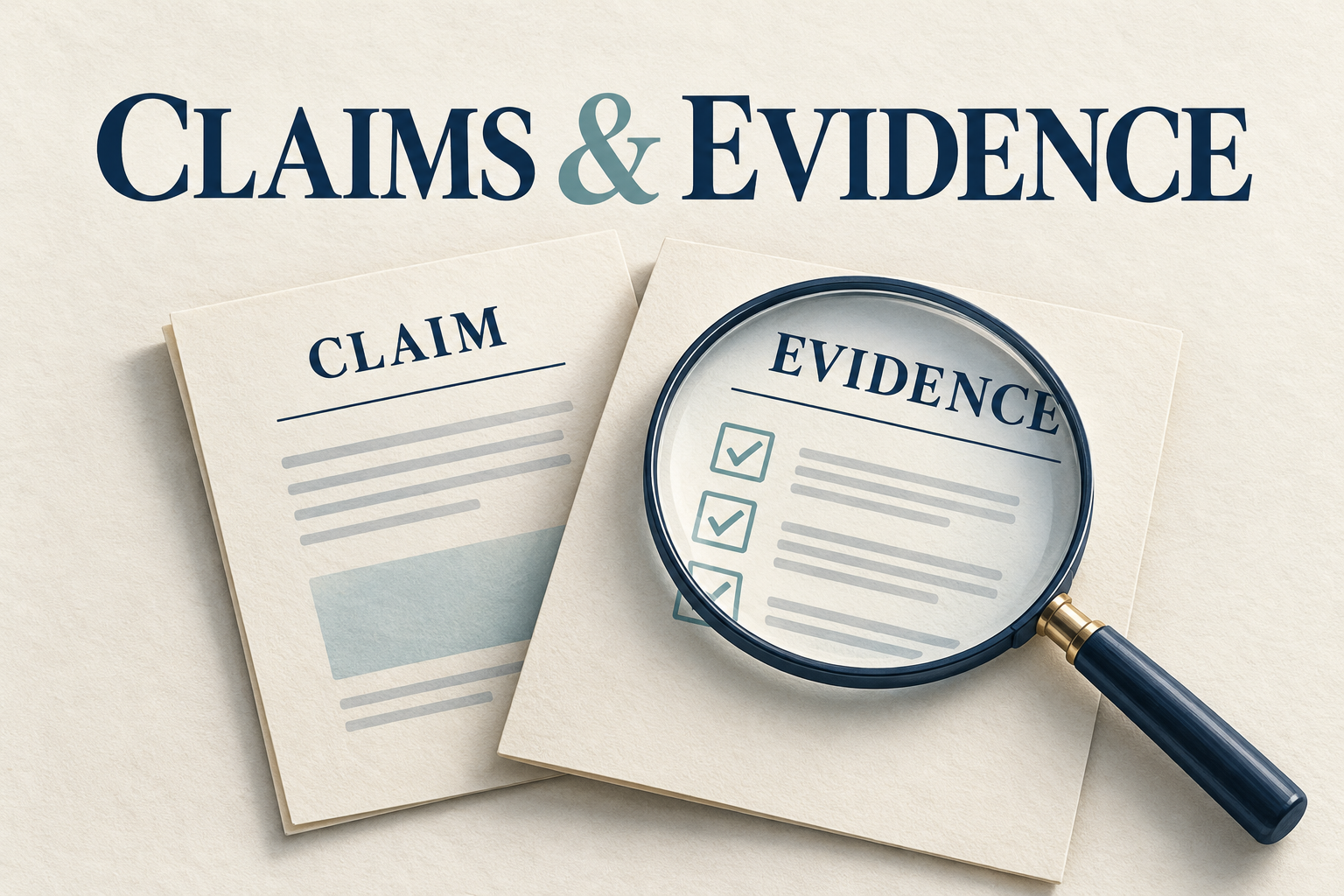
No. The article’s cover uses illustrative documents. It is not a photograph of a laboratory result or a certification.
Describe uncertainty plainly
Use specific language: the method is unavailable, the version is unclear, or the source covers a different model. That is more useful than presenting an unsupported confident conclusion.
Related reading
- Understanding Vape Product Labels: A Consumer Information Guide
- Advertised Puff Counts: Questions to Ask About the Claim
- QR Codes on Packaging: How to Evaluate the Destination
Editorial note: Prepared with AI assistance as an educational draft. No hands-on product testing or medical review is claimed.